After exploring Tohoku on my previous trip, I wanted to give another region of Japan the same attention. I had a little over two weeks available, from May 25 to June 9, 2026. The plan was to spend the first half exploring northwestern Kyushu, then return to Tokyo for friends, familiar places, and a concert in Yokohama.
Late May and early June are an excellent time to travel in Japan. Golden Week has passed and the holiday rush is over, although the rainy season is approaching: in northern Kyushu, it usually begins around early June.
As usual, I am starting with the preparation and the rough plan. This was the route I had in mind before departure.
Exploring Kyushu and Returning to Tokyo
This trip combined two different kinds of travel. Exploring one region in more depth had been great fun in Tohoku, and a welcome change from some of my previous Japan trips, where I had tried to cover more distance.
I had visited parts of Kyushu before, especially its cities, on my 2014 trip. This felt like a good opportunity to return and explore more of the region beyond them. I also wanted to make use of rental cars where they were useful, expanding the trip beyond the train network. From that idea, a route began to take shape: start in Nagasaki, make a loop through the surrounding area, and end in Fukuoka.
The second part would then give me enough time in Tokyo to meet friends and do some shopping, both of which had felt a little too short on my previous visit. Tokyo was not a city to rediscover from zero, but a place to return to at a more relaxed pace, with enough time for coffee, sento, good food and a concert in Yokohama. Kamata, close to Haneda Airport, was a practical base for both the arrival from Fukuoka and the early flight home.
Planning for Early Summer
The main weather consideration was the small risk of an early typhoon affecting the coast or domestic flights. I first considered going south to Shimabara and Unzen, as well as further offshore to Iki and the Goto Islands in Nagasaki Prefecture, but decided not to include them in the final plan. They would have added more connections and made the route less flexible.
Luggage was another consideration. For the Kyushu part, I opted for a carry-on strategy and planned to send my large suitcase ahead to Tokyo. That would make the smaller transfers and hotels much easier, while still leaving enough space for shopping later in the trip. I also wanted to stay longer in one place, with fewer hotel changes and less time moving luggage than on earlier trips, where I often moved hotels every day. Two nights each in Nagasaki, Sasebo and Takeo, followed by two nights in Fukuoka, seemed like a good compromise between seeing different areas and actually settling into them.
How the Route Took Shape
My international flights arrived at and departed from Haneda. I found a reasonably priced flight from Basel via London to Haneda, then independently booked two domestic flights: one to Nagasaki at the beginning of the trip and one from Fukuoka back to Haneda after Kyushu.
I had initially considered a short visit to Huis Ten Bosch after Nagasaki. It was one more benefit of using Sasebo as a base, alongside its harbor, long shopping arcade and easy access to the coast. I was especially interested in the drive to Hirado and Ikitsuki, where churches, fishing towns, quiet roads and sea views come together. The Kujukushima cruise was another reason to stay for two nights.
Takeo would be the quieter part of the route: an onsen hotel, some time to slow down, and one full day around the ceramic towns. Saga Prefecture regularly comes last in Japanese prefectural-attractiveness polls, which sounded like a good reason to be curious. Surely there had to be something there. Arita was the obvious name, especially the older streets around Kami-Arita and the Kyushu Ceramic Museum. I also wanted to visit Okawachiyama. Karatsu and the coast would remain optional, depending on the day.
Fukuoka would bring the trip back to a larger city. I was looking forward to its compact, busy urban character and, above all, its food culture: unagi, ramen, izakaya food and the yatai stalls along the river. I also planned a day trip to Kitakyushu, combining the old port at Mojiko with the railway museum and the TOTO Museum.
The return to Tokyo was not entirely flexible: on June 3, I had a ticket for a ZUTOMAYO concert in Yokohama. That was the reason I needed to leave Fukuoka on that particular day.
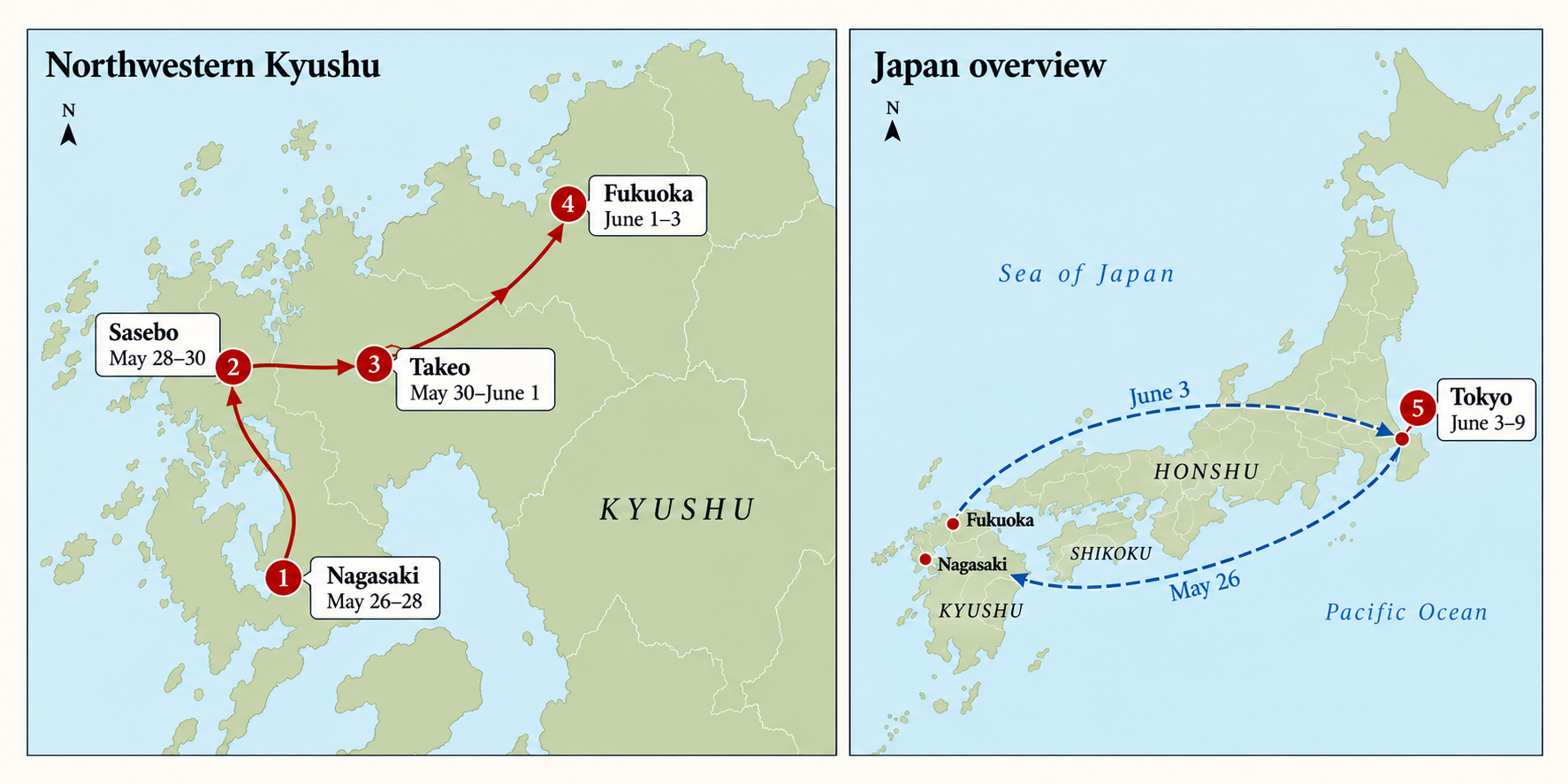
Route Overview
- May 25–26: Basel → London → Haneda → Nagasaki
- May 26–28: Nagasaki
- May 28–30: Sasebo, with Hirado, Ikitsuki and Kujukushima
- May 30–June 1: Takeo and the Saga ceramics area
- June 1–3: Fukuoka, with a day trip to Kitakyushu and Mojiko
- June 3–9: Tokyo, based in Kamata
- June 9: Haneda → London → Basel
First, though, I had to get from Basel to Nagasaki, with a few hours between flights at Haneda.
Japan 2026 · Part 1 of 12
Coming next: A Journey Starts at Home: From Basel to Nagasaki.
Entdecke mehr von Tabimonogatari - 旅物語
Melde dich für ein Abonnement an, um die neuesten Beiträge per E-Mail zu erhalten.